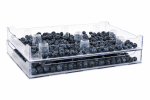
Kælt, a transport packaging concept designed to improve the cooling of fresh produce, has been selected as a finalist of De Gouden Noot, the international packaging innovation contest organised by NVC Packaging Centre. Reaching the final is a significant recognition for Kælt and the thinking behind the concept.
First organised in 1958, De Gouden Noot is described by NVC as the world’s most competitive packaging innovation contest. Entries are assessed by an independent jury on their overall level of innovation, looking beyond the packaging itself to its role and value in the wider packaging process and supply chain.
For NNZ, reaching the final provides an opportunity to present the idea behind Kælt and the challenge it aims to address: can packaging itself contribute to more effective and homogeneous cooling of temperature-sensitive fresh produce during transport?
Why cooling during transport matters
For delicate fresh produce such as blueberries, temperature management plays an important role in maintaining product quality. Cold air may enter a transport package, but that does not necessarily mean that it reaches all parts of the product load equally.
Differences in airflow can result in differences in cooling. Some areas may cool relatively quickly, while others remain warmer for longer. Kælt was developed to address this challenge through the design of the transport packaging itself.
Guiding cold air through the product
At the heart of the concept is the Kælt Plate. The perforated plate creates space for cold air to move underneath the product. Nine vertical air chimneys, positioned in a 3 × 3 configuration, guide the air upwards through different areas of the product load.
Instead of relying solely on cold air entering through the sides of the transport packaging, the Kælt design aims to distribute airflow more evenly throughout the product. In this way, the packaging itself becomes an active part of the cooling process.
Does the principle work?
Initial proof-of-principle testing has been carried out with blueberries using retail trays. During the test, cooling air at 5°C was introduced and temperatures were measured at different positions within the product load.
The results indicate more homogeneous cooling across the load, providing a first validation of the airflow principle behind Kælt under the tested conditions. The tests do not yet establish how much additional shelf life or reduction in product loss Kælt could achieve under commercial transport conditions.
From cooling to value
Better cooling is not the objective on its own. The potential value of Kælt lies in what more homogeneous temperature management could mean for the fresh produce being transported. If this helps maintain product quality, it could potentially result in more saleable product, fewer downgrades and less product loss.
For relatively high-value fresh produce, even a small improvement can have economic significance. As an illustrative example, a pallet containing 144 kg of blueberries at a product value of €21 per kg represents €3,024 in product value. If 5% more product remains saleable, this would represent 7.2 kg of additional saleable product, with a value of €151.20.
This is an illustrative calculation rather than a demonstrated Kælt result, but it shows why the relationship between cooling performance, product preservation and economic value is worth investigating further.
Looking at the complete transport solution
Cooling performance is only one part of the assessment. The Kælt Plate and its air chimneys occupy space within the transport packaging, which could affect how much product can be transported per pallet.
Potential improvements in product preservation therefore need to be weighed against packaging cost and pallet utilisation. Ultimately, Kælt needs to demonstrate that the complete transport solution can deliver more value per shipment.
Being selected as a finalist of De Gouden Noot is an important milestone in that development. The next step is to validate whether the cooling principle can translate into measurable improvements in product quality, reduced product loss and a positive business case under commercial transport conditions. See our transport packaging solutions for fresh produce.
Want to know more about Kælt?
"*" nurodo būtinus laukelius
Slapukus naudojame siekdami optimizuoti jūsų naudojimosi svetaine potyrius, analizuoti svetainės lankytojų srautą ir rodyti aktualias reklamas. Apie tai, kaip naudojami slapukai ir kaip gal suasmeninti savo pasirinktis galite sužinoti daugiau paspausdami „Nustatymai“. Jei su mūsų slapukų politika sutinkate, spustelėkite „Patvirtinti visus“ slapukus.
Šie slapukai naudojami optimizuoti svetainės veikimą ir funkcijas. Tokie slapukai svetainės naršymo metu nėra svarbūs. Vis dėl to, gali būti, kad be slapukų kai kurie svetainės elementai tinkamai neveiks.
Šie slapukai naudojami rinkti duomenis, kuriuos naudojame siekdami suprasti kaip mūsų svetainės naudojama ir suprantama. Tokie slapukai mums taip pat padeda optimizuoti svetainę ir užtikrini geriausius naudotojų potyrius.
Šie slapukai reklamų tinklams leidžia stebėti jūsų elgseną internete, kad remiantis jūsų elgesiu internete ir pomėgiais būtų galima rodyti aktualias reklamas. Tokie slapukai taip pat neleidžia nuolat rodyti tų pačių reklamų.